
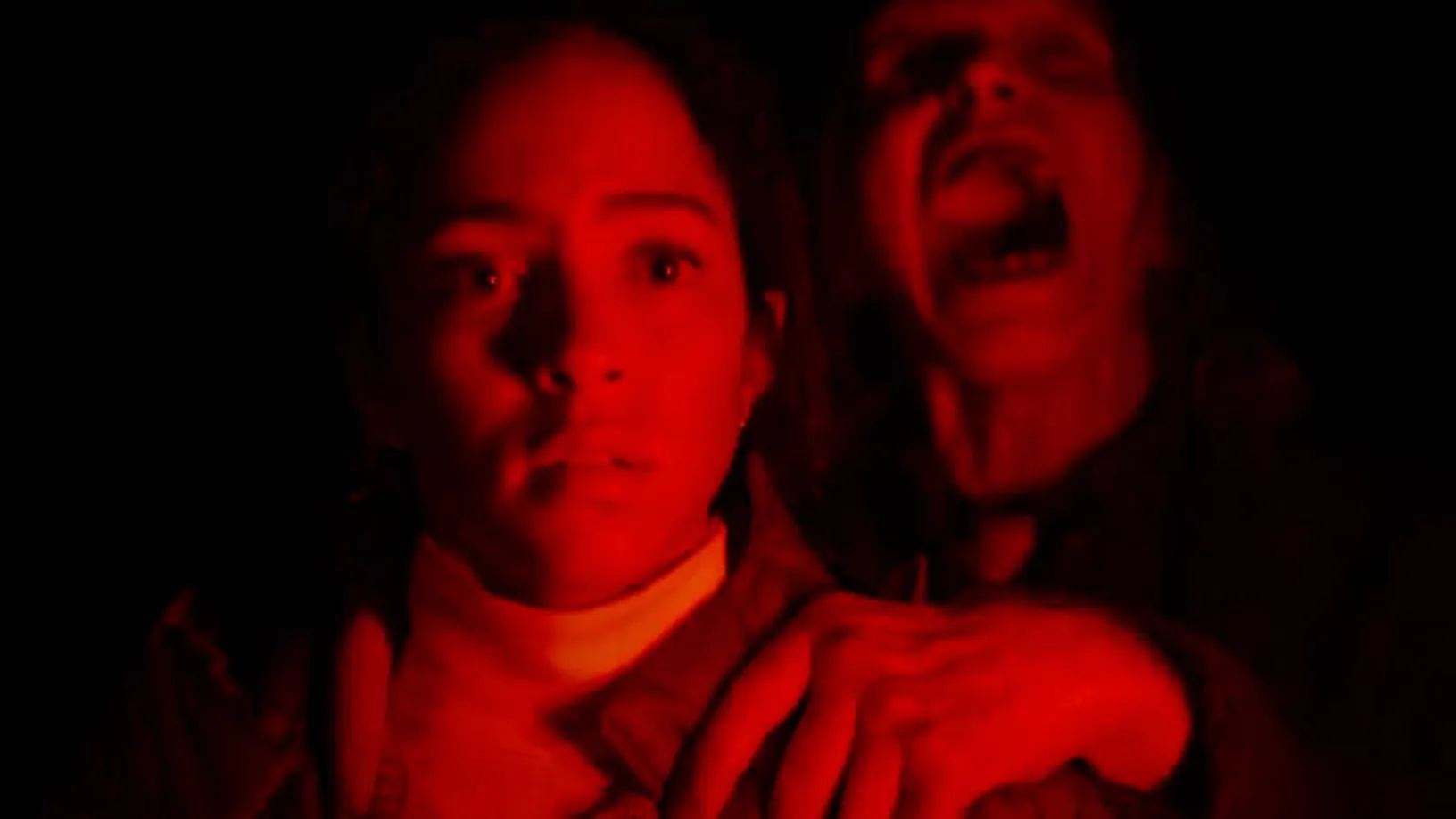
For at least a couple of decades, road horror films were the best the United States had to offer to the delight of fans of the genre—just think of gems like The Hitcher (the 1986 version starring Rutger Hauer, of which there is also a 2007 remake). Bringing the subgenre back into vogue is Passenger, in theaters starting May 21, by André Øvredal, a Norwegian director (like Tommy Wirkola of Dead Snow) who previously helmed the witch story The Autopsy of Jane Doe, the mythological Mortal, and the vampire film Demeter: The Awakening of Dracula.
As Jeepers Creepers teaches us, it never bodes well in horror films (nor in The X-Files or Twin Peaks) to wander alone or in pairs—especially at night—on the isolated, desolate roads that wind through American forests. Tyler (Jacob Scipio) and Maddie (Lou Llobell) are completely oblivious to this; for them, living on the road has become a way of life. The young couple left behind a stable life in New York to embrace a nomadic existence—a dream Tyler has cherished his whole life.
As the weeks go by, Maddie begins to struggle with the lifestyle of living out of their car, showering at 24/7 gyms, and camping out with other travelers in the woods. During a nighttime drive, the two come across the victims of a devastating car accident. From that moment on, an evil presence begins to haunt them, forcing them to find a way to break free from the curse that has plagued travelers on the road at night for centuries.
At first, Passenger plays on uncertainty: is there really a supernatural entity hunting Maddie and Tyler, or is it the effect of the psychological impact that the trauma of seeing the mutilated bodies in the accident has on the girl? Ominous shadows, unsettling silhouettes that vanish behind trees or turn out to be mere tricks of nature, faces that appear on the dashcam only to vanish, omens, and an intriguing mythology circulating among RV travelers shroud the protagonists in doubt but do not deceive the viewer. The viewer knows that a sort of moldy Bob from Twin Peaks is having fun terrorizing his prey before killing them.
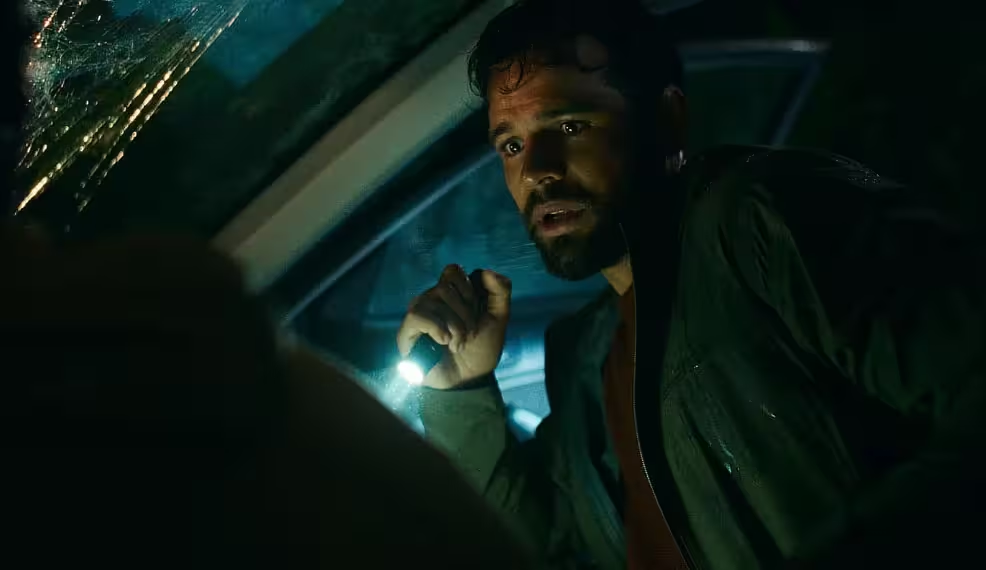
Melissa Leo, playing a veteran nomad who warns Maddie about the supernatural dangers of the road and its unwritten rules, is the only character who deserved a bit more depth. Where Passenger really shines isn’t so much in its protagonists (the young woman raised with trauma and the family’s golden child) but in the fusion of folklore and religion that envelops the narrative—an element that also distinguishes the Scandinavian director’s previous works. The film is a treasure trove of jump scares worthy of Final Destination.
Øvredal boasts confident direction and a keen sense of how, when, and how much to distribute the scares throughout the film without merely exploiting them. Passenger is a labor of love: as the jump scares grow closer together, the moment when the demonic traveler will take the lives of his victims draws nearer. The film offers some truly beautiful scenes: the first, disturbingly realistic, set in a dark parking lot, and the second, a splendid, intimate take on a drive-in where images from Roman Holiday are reflected on the elements of the forest with terrifying results.
The Norwegian director is a master of the genre even in his presentation: he skillfully alternates between the real and the supernatural, relies on practical effects to set himself apart from contemporary, CGI-heavy American horror films, and makes extensive use of atmosphere, music, and the soundscape in general. For much of its runtime, Passenger relies on horror by omission to generate tension and a creeping sense of dread. The final act is entirely rooted in religious horror.
The signs were all there: the medallion of St. Christopher, patron saint of travelers, hanging in Tyler and Maddie’s van; the barely visible detail of the priest’s cassock worn by the demonic figure. Over time, the overlap between the sacred and the profane becomes evident, as do the legends of folklore and Christian parables that describe the same ancestral threat. The final sequences are a religious and iconoclastic triumph. As skilled and gifted with flashes of ingenuity as he is, Øvredal once again lacks that excess and madness that an Oz Perkins or a Robert Eggers have in their DNA—and that is what makes a horror film memorable.
