
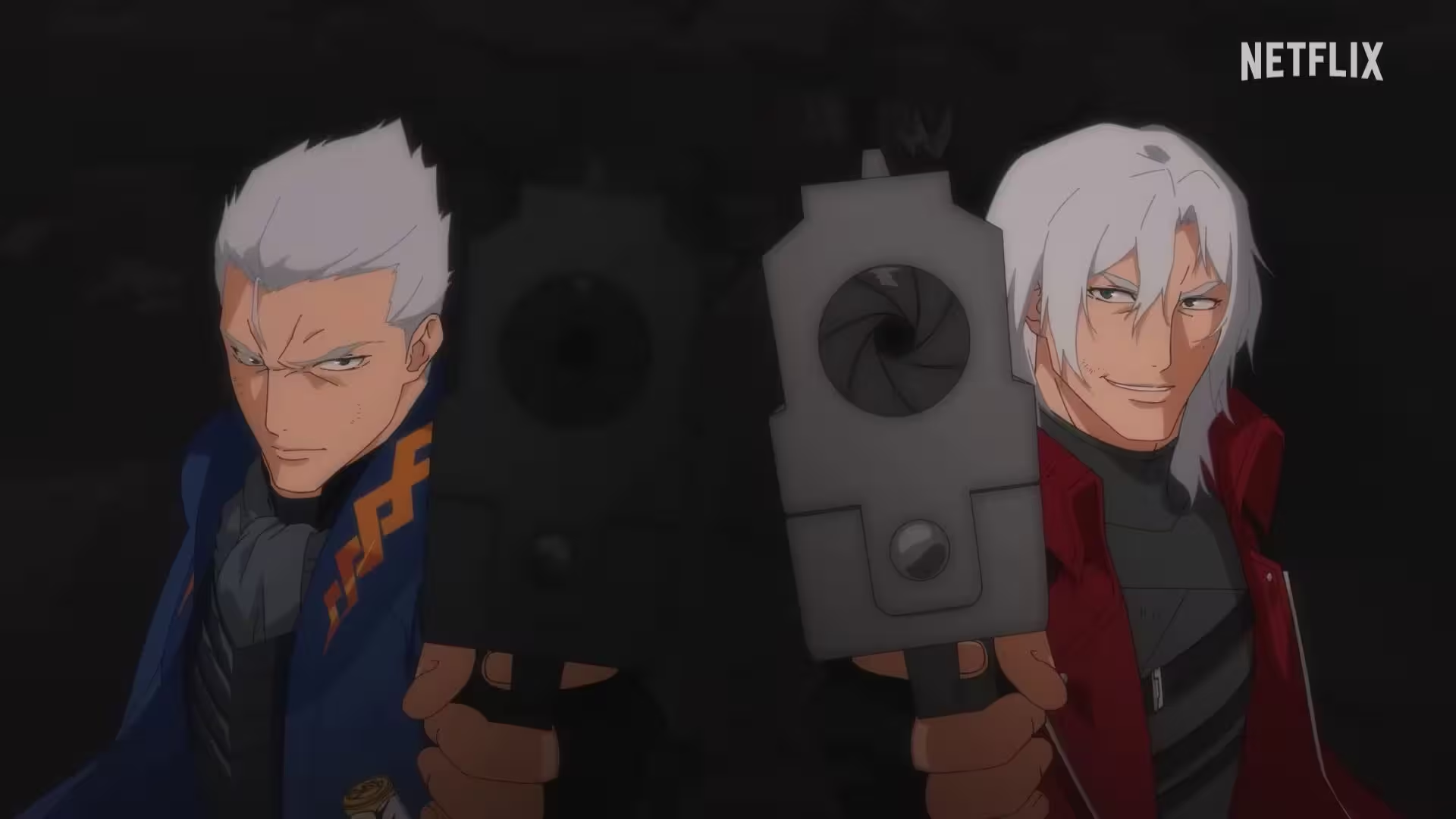
After years in the making—consider that the announcement dates back to 2018—the animated series inspired by Devil May Cry is now in its second season, just one year after the first: It was strongly championed by the multifaceted producer Adi Shankar, a die-hard fan of the Capcom series, who drew only loose inspiration from the video games’ plot, writing a story set in a parallel universe that serves as an ideal entry point for those unfamiliar with Devil May Cry, yet at the same time has upset longtime fans.
What upset fans were not only the changes made to the plot and characters, but also the introduction of rather intrusive political themes, as well as mediocre computer graphics during the series’ climactic moments. Many viewers unfamiliar with Dante and his universe, however, appreciated the animated series produced by Studio Mir more. Who will this new season prove right?
Between Hell and Earth
We’ll tell you right off the bat that the second season of Devil May Cry immediately tones down the political subplot: at the end of the first season, it seemed that the ambitious President Hopper was about to invade Makai—that is, the hellish dimension—but Vergil’s arrival on the scene causes the United States to back down. The series’ political undertones quickly fade away, along with a muddled parody of the U.S. administration—especially considering that Shankar is a staunch Trump supporter, which makes certain narrative choices even more baffling—to make way for the intrigues within and outside the Uroboros Corporation.
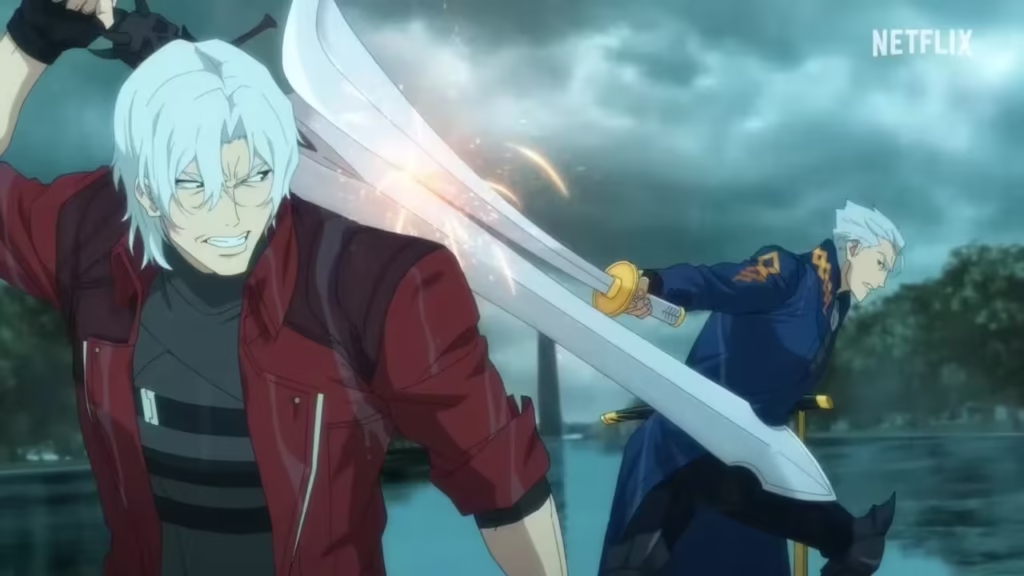
The new season thus follows three main storylines, bringing them together only halfway through: Dante’s, as he continues to search for his place in the conflict between Earth and Makai; Lady’s, torn between her loyalty to DARKCOM and, in particular, to Vice President Baines; and finally Vergil’s, who has returned to Earth after growing up in Makai to help Mundus, the ruler of the underworld, conquer it. The reunion, years later, between the two brothers turns their worlds upside down, especially when Arius finally drops the mask, revealing his intention to gather powerful artifacts called Arcana to awaken the demon Argosax; at that point, Sparda’s two sons have no choice but to join forces against the new threat.
Just like Castlevania, Devil May Cry is also a character-driven series, especially in this season, which features a much straighter and more linear plot, interspersed with numerous heart-pounding action scenes. By shedding the political and existential subplots, the series gains more time to devote to the protagonists, and especially to Vergil, the true star of this batch of episodes, who is decidedly more multifaceted than his original video game counterpart, who was much more one-dimensional.
Shankar and his writers drew primarily on the plot of the video game Devil May Cry 2, reworking its key elements (the rebirth of Argosax, the Arcana, Arius’s role, and so on) to fit their vision. The season concludes, however, with a major cliffhanger that hints at a likely third season.
Although it doesn’t feature any major plot twists, the second season of Devil May Cry captures the viewer’s attention thanks to its numerous flashbacks, which gradually flesh out the main characters and the antagonist Arius, giving them the necessary depth, sometimes employing different narrative styles and techniques. Ironically, Dante and Lady come out of it a bit battered: the former only truly develops as a character by the end of the season, while the latter has been toned down somewhat in terms of her foul language—a trait many noticed in the first season that carries a bit less weight here. Lady, too, remains somewhat on the sidelines, but it’s clear that a potential third season will revolve entirely around her and her conflict with her father.
Better or worse than the first?
The new batch of episodes—eight, just like last time—has a more polished pacing: while not sacrificing psychological introspection, Studio Mir’s series stages fights and shootouts to the hilt, often enhanced by over-the-top, dynamic, and precise direction. The animation has improved significantly compared to the first season and is now smoother, especially during the most important battles: particularly whenever Dante and Vergil cross swords.
Their duels are the best in terms of complexity and spectacle, but the season also features some surprising, large-scale battles, especially in the final episodes, which take up most of the runtime. It’s just a shame that the computer graphics haven’t improved at all, especially when the two brothers transform into demons.
The art direction is also questionable, not so much in the character design—which you may or may not like—but in everything else, especially the monotonous settings. Despite having the extremely diverse imagery of video games at its disposal, the second season of Devil May Cry takes place almost entirely at the DARKCOM base, partly in the city but mostly indoors, and only minimally in the desolate Makai: there is therefore a certain visual monotony, though the weakest point of this Netflix production is the music—or rather, its distribution throughout the series.
Once again, Adi Shankar Animation secured the rights to songs by famous bands like Papa Roach, Evanescence, and Drowning Pool, but the frequency with which we hear their songs is such that they become intrusive and sometimes even cloying, eliciting an emotional response exactly opposite to what Shankar likely hoped for.
Conclusions
As you may have gathered from reading this review of Devil May Cry, the second season largely maintains the same level of quality as the first: it sets aside political subtext to focus on action and a story that gets straight to the point, featuring numerous beautifully animated action sequences. Focused primarily on the character of Vergil, this new batch of episodes is a spectacle of blood, emotion, and music, but it ends by leaving far too many loose ends that only a third season can tie up. It probably won’t convince Adi Shankar’s detractors to give him a second chance, but if you enjoyed the first season, you’ll definitely like this one too.
